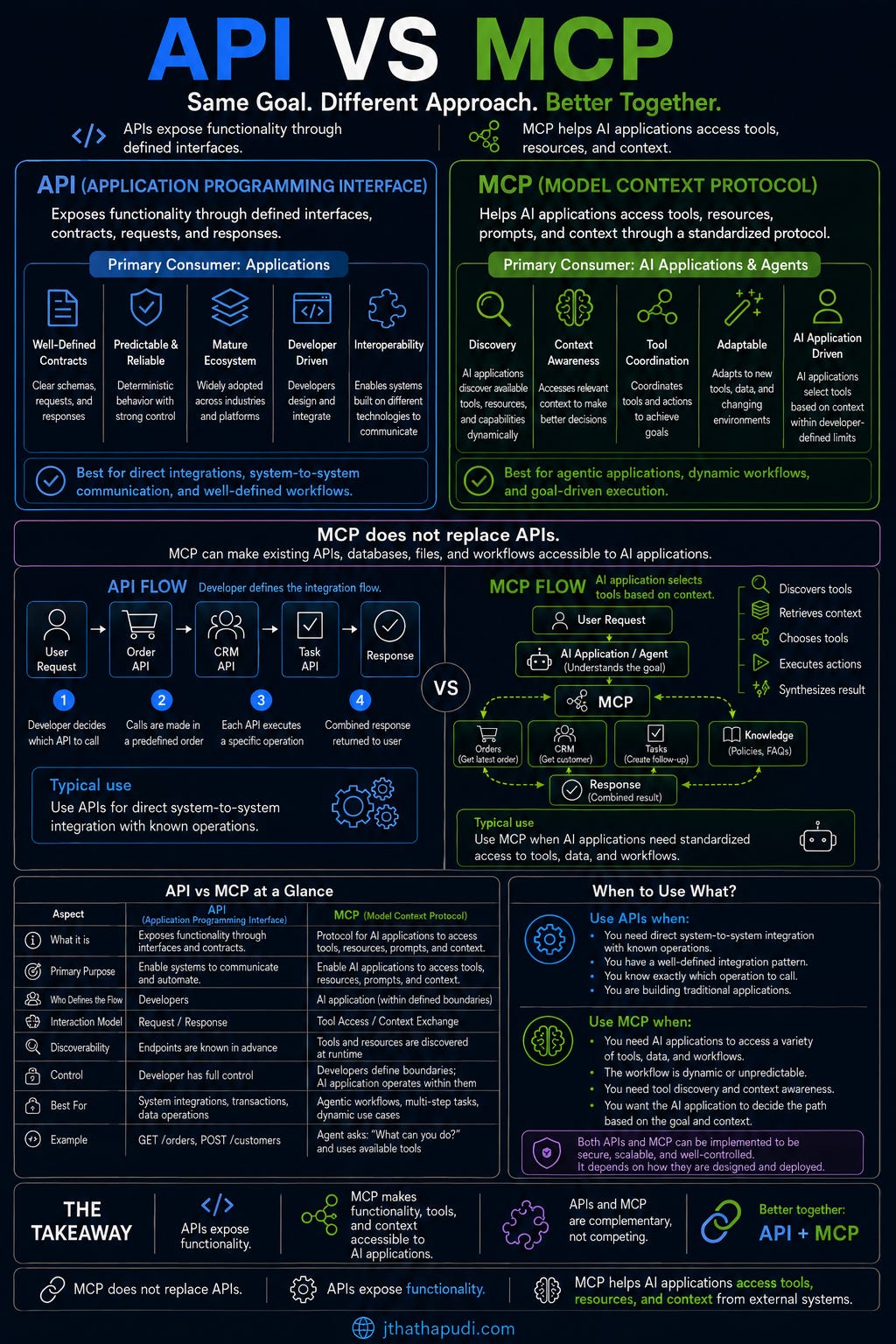
API vs MCP is not about which one is better.

It is about what each one is designed for.

APIs have been one of the foundations of modern software integration. They provide defined interfaces for software systems to communicate with each other.

A traditional application usually knows exactly which API to call, what request to send, and what response to expect.

MCP — Model Context Protocol — is different.

MCP provides a standardized way for AI applications to access tools, resources, prompts, and context from external systems.

That distinction matters because AI applications often work differently from traditional applications.

A traditional app usually follows a predefined flow.

An AI application may need to:
- discover available tools
- retrieve relevant context
- choose which action to take
- call the right tool
- synthesize a response for the user

This does not mean MCP replaces APIs.

In many real-world architectures, MCP can sit on top of existing APIs, databases, files, and workflows.

A simple mental model:

APIs expose functionality.

MCP makes functionality, tools, and context accessible to AI applications.

APIs are useful when the operation and integration flow are known.

MCP is useful when an AI application needs standardized access to tools and context across systems.

Different purpose.
Different layer.
Often used together.

Better together: API + MCP.

As AI applications become more common in enterprise systems, this distinction will become increasingly important.

The question is not “API or MCP?”

The better question is:

“How do we expose existing systems in a way that both applications and AI agents can safely use?